Continuous context
for product teams
From discovery to delivery.
The unified understanding of the what and the why behind every task.
Across your team, your tools, and every agent.
Compounds every cycle.
No spam - just Quack Stack updates. Privacy policy


Your team is growing.
Is context scaling?
Small team, one room: everyone hears the customer calls, the support themes, the competitor news. Decisions are fast because context is shared.
Then you grow. Slack threads nobody saw. A wiki nobody updates. Tickets with no line back to the customer who asked. The picture that used to be obvious is split across people and tools - going stale while you ship.
Then AI arrived. Everyone built their own stack - own Claude Code, own prompts, own sources, own private picture of the work. Individually, everyone's sharper. Collectively, nobody's on the same page.
There's a name for this: AI-stack fragmentation. For some teams that's coming. For others it's already here. The agents running on your team's work don't build their own picture - they read whatever shared context you've built. Without one, they're shipping fast from an incomplete picture.
CI/CD fixed deployment.
Continuous Context fixes alignment.
Product tools assume someone writes a spec. Engineering tools assume someone hands you a task. Neither fits how teams actually work now.
Quack Stack sits in between.
One context layer. Every surface. Every role.
From signals to shipped
A continuous loop that gets smarter with every cycle.
Collect
Customer interviews. Support tickets. Competitor moves. Market trends. Your team's meeting notes and decisions. All flowing into one place, continuously.
Understand
Signals become ranked opportunities, each traced back to real evidence. Expert agents modelled on your ICP pressure-test every opportunity before it reaches your team.
Validate
Design experiments with real hypotheses and kill criteria. Run structured interviews. Know when to double down and when to walk away - before you commit engineering time.
Deliver
Engineers query customer signals in their IDE. PMs get morning briefs in Slack. AI agents pull the full evidence via MCP. Same intelligence, every surface, every role.
Measure
Shipped features are tracked automatically. What worked sharpens future priorities. What didn't reshapes your understanding. The loop closes and the picture gets clearer.
Three ways to start
You do not have to roll out the whole loop on day one. Pick the entry point that lines up with where the friction is, and add the others when you are ready.
Connect your terminal / IDE
Run quack login and your Claude Code, Cursor, or shell reads from the team brain. Your local CLAUDE.md and prompts stay put.
Personal upgrade. No team workflow change.
Connect your customer voice
Point Zendesk, Intercom, or HelpScout at us. Opportunities surface from real tickets, continuously.
Nobody else has to change how they work.
Connect your team channel
Slack morning brief and ad-hoc questions in the channel everyone is already in. No dashboard required.
Value the day after install, in a tool they already use.
All three feed the same picture. Add the others when you are ready. Keep your tracker, keep your local workflow, keep your tech docs in the repo.
Continuous context from your whole stack
 Slack
Slack  Zendesk
  Intercom
  HelpScout
  Notion
  Granola
  GitHub
Product tools assume someone writes a spec.
Engineering tools assume someone hands you a task.
Neither fits how teams actually work now.
From the blog
Ideas worth your time

Your team's AI stack is about to fragment, and you won't see it happen
Every team member is building their own AI setup. That doesn't scale, and it's about to break. Here's why we think the fix is a team-level shared brain, not a better personal stack.
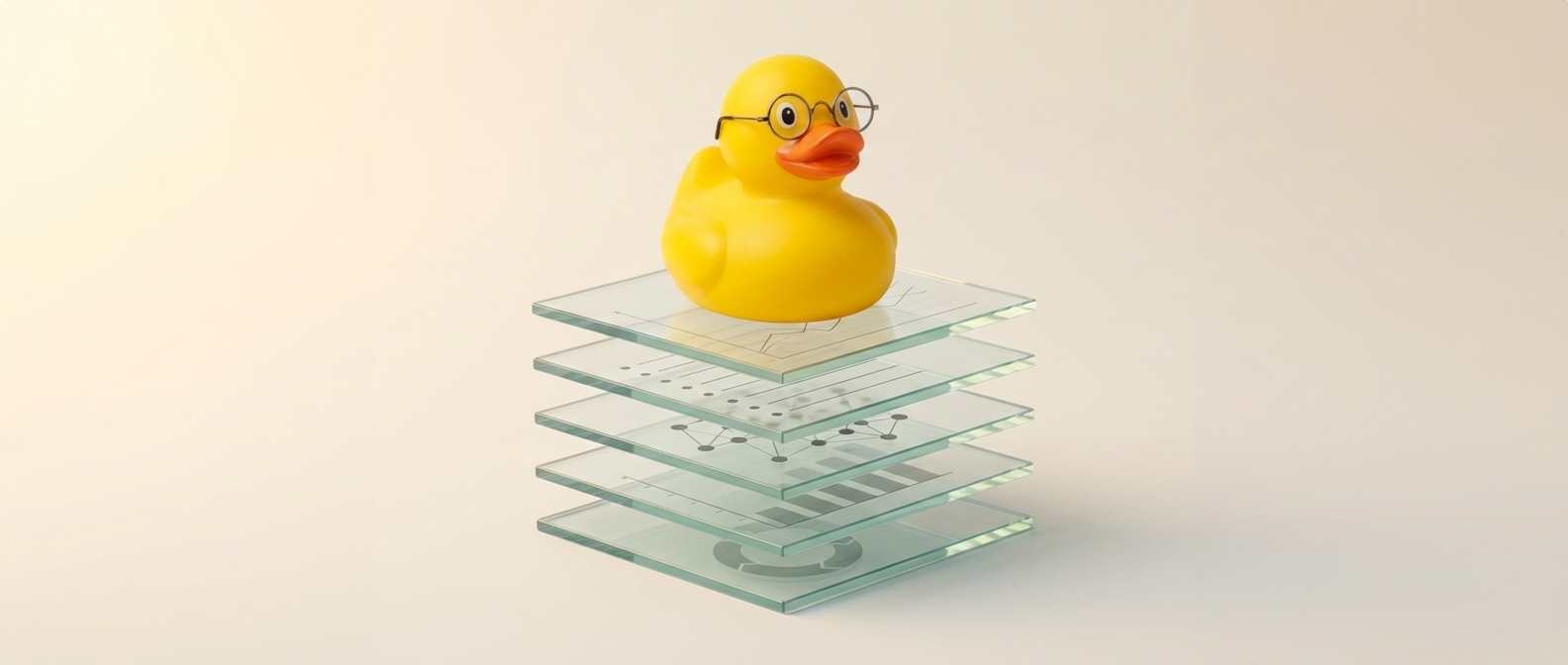
Why we built Quack Stack
The wall between deciding what to build and building it has collapsed. Here's what we're doing about it.
Stop guessing.
Start knowing.
See how Quack Stack gives your whole team - product, engineering, and AI agents - continuous context on what to build and why.